Network Science

by Kayla Aguilar, Maris James, and Aynsley S.

Data is all around us, but it has to be studied in some way, right? How else are we supposed to know what it’s about? That’s what graph theory and network science are for! To organize and connect data mathematicians use networks and graphs as well as scientific computing (like coding).

Network science is an application-based study of graphs. To understand network science, we first have to understand the graphs:

Graph Theory

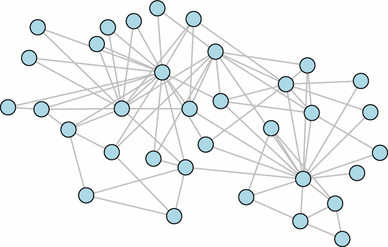
Graphs represent data through nodes, which are the separate points of a graph, and edges, which connect the nodes. There are two types of graphs: directed and undirected graphs. Directed graphs rely on the order of the vertices to be the same, while undirected graphs don’t rely on the order of the nodes.

Continue reading

Classification of Surfaces

by Camille Clark, Layke Jones, Aekta Kallepalli, Maya Mukerjee, and Caroline Zhou.


Euler Characteristics

Euler characteristics

Euler characteristics are defined by the equation V- E + F = 2 where V = number of vertices, E = number of edges or nodes, and F = number of faces. Sometimes though, the equation V – E + F = 2 does not work for all situations because the solution can give various outcomes due to the dimensions and simplicity of the object. If 2 objects are topologically the same, they will have the same Euler characteristics. For all simple polygons, the Euler characteristics equal one. Figures with holes don’t follow these conventions as the holes in these figures add additional faces and edges not proportional to the formulas for simple figures.

Continue reading

Knot Theory

by Erin Gottschalk, Simon Johnson, Meghan, Elizabeth Nguyen, and Brooke Rogers*.

*Brooke helped the group work through the problem set but was unfortunately unable to attend camp during the blog writing.

What We Did:

Knot theory has many different applications in math including algebra and geometry, and (outside of math) physics. We learned that we can use algebraic techniques to describe knots. When trying to understand knot theory we learned that it is very helpful to work in a group and read the definitions out loud. Us working together was key in understanding knot theory.

Continue reading

RSA Encryption Cryptography

by Lily Taylor, Zoe Tobien, Tehya Weaver, and Tayloir Wiley.

RSA Encryption Cryptography

What is RSA Encryption Cryptography?

RSA was one of the first public-key* cryptosystems and it is widely used for secure data transmission. It was first created by Ron Rivest, Adi Shamir, and Leona Adleman.

*Public key is used to establish a secret key, and the public key is sent in public. We then use the private key method to encrypt and decrypt large amounts of data, but no one knows the private key.

  • To code: U^s=x X(mod N)=Y
  • To decode Y^t=O O(mod N)=U

In computing, the modulo operation finds the remainder after division of one number by another. Given two positive numbers, a and n, a modulo n (in other words a mod n) is the remainder of the a division of a by n, where a is the dividend and n is the divisor.

Continue reading

Elliptic Curve Cryptography

by Alana Drumgold*, Lauren Flowers, Emily Huang, Tamarr Moore*, and Ashleigh Sico.

*Alana and Tamarr helped the group work through the problem set but were unfortunately unable to attend camp during the blog writing.

For years, people have been trying to find a way to send secret messages. This may have been easy to do in the ancient times of the Roman Empire, where you could write a message, and then hand-deliver it to your recipient.  This way, you could be certain that nobody else could intercept it. However, this becomes a lot more difficult in today’s online tech-driven world. People no longer hand-deliver letters; rather, we email or text our friends.  So how do we make sure that nobody else can intercept your text message as it travels the internet before finally landing on your friend’s cell-phone? The answer is found in cryptography, a technology that is becoming more and more important in today’s world.  Today, we are going to focus on one particular form of cryptography: elliptic curve cryptography.

Continue reading

Mathematical Epidemiology

By Camilla Fratta, Ananya Jain, Sydney Mason, Gabby Matejowsky, and Nevaeh Pinkney*.

*Nevaeh helped the group work through the problem set but was unfortunately unable to attend camp during the blog writing.

Mathematical Epidemiology explores the realm of mathematics applied to public health. It relies on modeling to use known information about certain scenarios regarding the spread of diseases and then uses it to predict future outcomes. By the end of the problem set, our group learned about the challenging process that comes with trying to predict population sizes in order to control the spreading of diseases. The equations that are faced in this branch of mathematics are at the heart of mathematical modeling.

Mathematical Models and Modeling

A mathematical model is an equation used to predict or model the most likely results to occur in a real-world situation.  We used these types of equations to model the spread of a disease in a population, tracking the flow of populations from susceptible to infected to recovered.  In real life scenarios, there are too many variables to fully account for, so we only were able to place a few in our equations. This made the models less accurate, but at the same time very useful to us in our problem set.  They gave us a good idea of how things worked in an actual epidemic and helped us to understand what mathematical modeling really is.

Continue reading

Quantum Mechanics

By Izzy Cox, Divya Iyer, Wgoud Mansour, Ashleigh Sico, and Elizabeth Whetzel.

Quantum Mechanics is the physics of molecular and microscopic particles. However, it has applications in everyday life as well. If someone asked you if a human was a particle or a wave, what would you think? What about a ball? What about light? Not so easy now, is it? It turns out that all of those things, and in fact, everything around us, can be expressed in physics as both a particle and a wave. This might seem a little unbelievable, but for now, let’s start with the basics.


Classical Physics

Although Classical Physics sounds like a complicated idea, it’s the most simple branch of physics. It’s what you think of when someone says “physics”. Classical Physics lays the basic foundation to Quantum Physics with a few basic laws.

Continue reading

Knot Theory

By Jillian Byrnes, Monique Dacanay, Kaycee DeArmey,  Alana Drumgold, Ariyana Smith*, and Wisdom Talley*.

*Ariyana and Wisdom helped the group work through the problem set but were unfortunately unable to attend camp during the blog writing.

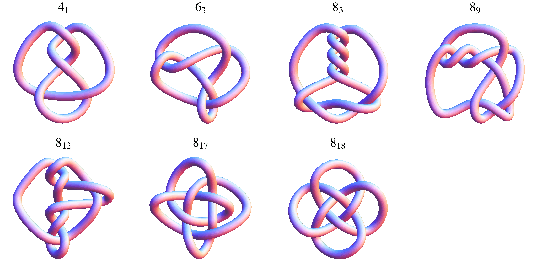
A mathematical knot is a loop in three-dimensional space that doesn’t intersect itself, and knot theory is the topological study of these knots. Two knots are considered to be equivalent if they can be stretched or bent into each other without cutting or passing  through themselves. The simplest of these knots is known as the unknot, which is just a circle or its equivalence. Similar to a knot is a link, which is multiple knots intersecting each other. Both knots and links are often described in the form of knot diagrams, which are two-dimensional representations of the three-dimensional shape. There are an infinite number of both knots and links, but here are a few examples in diagram form:

Continue reading

Classification of Surfaces

By Ayanna Blake, Lisa Oommen*, Myla Marve, Tamarr Moore, Caylah Vickers, and Lily Zeng.

*Lisa helped the group work through the problem set but was unfortunately unable to attend camp during the blog writing.

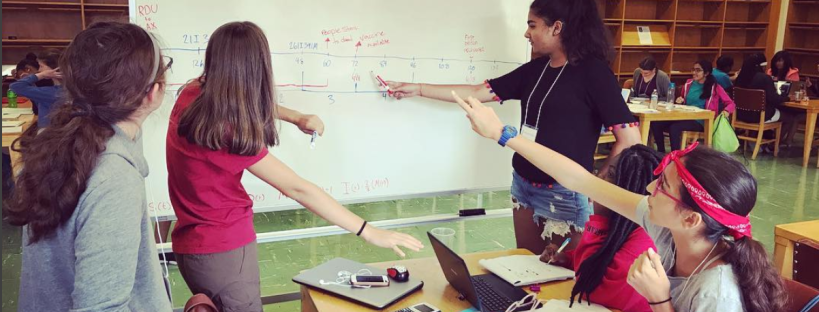
The Girls Talk Math camp is about female high school students from different places who discuss mathematics, mathematicians, and theories. We were split up into groups and were assigned different math topics to learn. Our topic was classification of surfaces, which is listed under the umbrella topic of abstract geometry.

We thought the surfaces project was very interesting and cool to learn about, because it introduced us to college level math and allowed us to understand different parts of geometry. Along with gaining knowledge of surfaces, we also got to learn about other groups topics. Campers presented their topics on the last day and helped us to perceive the significance of the different subjects.

Continue reading

Elliptic Curve Cryptography

By Mukta Dharmapurikar, Anagha Jandhyala, Savanna Jones, and Ciara Renaud.

Have you ever wondered how your credit card number stays secure after shopping online? Every day millions of people’s personal information is entered online or stored in databases, where it seems like anyone could access it. However, a process called cryptography keeps theft from occurring.

Cryptography is the ancient art of keeping secret messages secure. Elliptic curve cryptography is one type of encryption that we spent the last two weeks learning about. It has some advantages over the more common cryptography method, known as RSA.

RSA relies on the difficulty of factoring very large prime numbers. Despite the current security, it’s feasible that one day a method could be invented that makes factoring large prime numbers realistic. In this blog post, we will be explaining the essential math behind how elliptic curves work and how they are used to encrypt messages.

Continue reading