Mathematical Epidemiology

By Camilla Fratta, Ananya Jain, Sydney Mason, Gabby Matejowsky, and Nevaeh Pinkney*.

*Nevaeh helped the group work through the problem set but was unfortunately unable to attend camp during the blog writing.

Mathematical Epidemiology explores the realm of mathematics applied to public health. It relies on modeling to use known information about certain scenarios regarding the spread of diseases and then uses it to predict future outcomes. By the end of the problem set, our group learned about the challenging process that comes with trying to predict population sizes in order to control the spreading of diseases. The equations that are faced in this branch of mathematics are at the heart of mathematical modeling.

Mathematical Models and Modeling

A mathematical model is an equation used to predict or model the most likely results to occur in a real-world situation.  We used these types of equations to model the spread of a disease in a population, tracking the flow of populations from susceptible to infected to recovered.  In real life scenarios, there are too many variables to fully account for, so we only were able to place a few in our equations. This made the models less accurate, but at the same time very useful to us in our problem set.  They gave us a good idea of how things worked in an actual epidemic and helped us to understand what mathematical modeling really is.

Continue reading

RSA Encryption Cryptography

By Camille Clark, Layke Jones, Isabella Lane, Aza McFadden*, and Lizbeth Otero.

*Aza helped the group work through the problem set but was unfortunately unable to attend camp during the blog writing.

Cryptography is a field of coding and decoding information. It relies on the framework of number theory. Therefore, it can be used to connect theories as well as teaching others the fundamental properties of integers. Relevant number theory topics are modular arithmetic, prime factorization, greatest common divisor, and theorems such as the Chinese Remainder Theorem and Euler’s Theorem. This blog post will focus on the first three topics.

Continue reading

Quantum Mechanics

By Kathryn Benedict, Olivia Fugikawa, Denna Huang, and Eleanor McAdon

Intro

Quantum mechanics is a subfield of physics. Like with any other major area of study, physics is divided into many smaller categories. Classical physics is the main one, which includes Newton’s Laws of Motion and basic principles of mechanics, like inertia and friction. Things get weird when you delve into modern physics, which includes special relativity, general relativity, and quantum mechanics. Special relativity deals with particles moving at the speed of light, general relativity works with incredibly massive objects and quantum mechanics is the physics of subatomic particles. This is what we worked on for the past two weeks and what our blog post is about!

Continue reading

Network Science

by Kayla Aguilar, Maris James, and Aynsley S.

Data is all around us, but it has to be studied in some way, right? How else are we supposed to know what it’s about? That’s what graph theory and network science are for! To organize and connect data mathematicians use networks and graphs as well as scientific computing (like coding).

Network science is an application-based study of graphs. To understand network science, we first have to understand the graphs:

Graph Theory

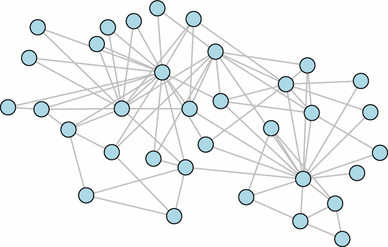
Graphs represent data through nodes, which are the separate points of a graph, and edges, which connect the nodes. There are two types of graphs: directed and undirected graphs. Directed graphs rely on the order of the vertices to be the same, while undirected graphs don’t rely on the order of the nodes.

Continue reading

Special Relativity

By Katie Clark, Tori Dunston, Kelly Fan, Abrianna Macklin, and McKenna Vernon

Picture a hummingbird. At any moment, it can go in any of the three dimensions it is a part of. So, it could go up and down, forwards and backwards, or left and right. But, one thing that is not taken into account is time. As it moves through space, it is also occupying time. However, we’re not used to thinking about our world in a four dimensional sense. But, as the movement of the pigeon progresses, so does time. This is known as the relationship between space and time, and it is the primary foundation that special relativity is built on. So, at any given moment, it actually can move in four dimensions at once. This can be simply modeled using a spacetime diagram.

lightcone3

Continue reading

Mathematical Epidemiology

by Jillian Byrnes, La’Ziyah Henry, Delphine Liu, Sophie Ussery, and Elizabeth Whetzel.

What is Mathematical Epidemiology?

What is mathematical epidemiology? Well, mathematical epidemiology is when mathematicians use math to predict outcomes in various statistical problems. These problems include growth in infectious bacteria, change in population, and even the effects of climate change. Why is this used? It is used because it doesn’t need a complete set of data to figure out a solution, as long as you can create an equation and plug in the values.

Who uses it? Mathematicians and scientists use it in fields such as biotechnology, medical science, civil engineering, and as public health professionals.

Continue reading

Classification of Surfaces

By Ayanna Blake, Lisa Oommen*, Myla Marve, Tamarr Moore, Caylah Vickers, and Lily Zeng.

*Lisa helped the group work through the problem set but was unfortunately unable to attend camp during the blog writing.

The Girls Talk Math camp is about female high school students from different places who discuss mathematics, mathematicians, and theories. We were split up into groups and were assigned different math topics to learn. Our topic was classification of surfaces, which is listed under the umbrella topic of abstract geometry.

We thought the surfaces project was very interesting and cool to learn about, because it introduced us to college level math and allowed us to understand different parts of geometry. Along with gaining knowledge of surfaces, we also got to learn about other groups topics. Campers presented their topics on the last day and helped us to perceive the significance of the different subjects.

Continue reading

Schoolhouse Rock—Dr. Candice Price Rocks!

By Clara, Ceren, Zoe, and Jess

Dr. Candice Price had always been good at math. But when her third-grade teacher presented “Schoolhouse Rock!–Multiplication Rock!” to her class, her passion truly began. The 30-minute multiplication lesson inspired her everlasting enthusiasm for mathematics. It is this inspiration that drove her to be the accomplished female mathematician that she is today.  

Continue reading

Renewable Energy @ WPI

by Jess, Jianna, Jaelani, Karen, and Layomi

First of all, let’s start with what fossil fuels are. Fossil fuels are fuels derived from natural resources such as coal, oil, and natural gas. These resources are not reliable because they will not be renewed in the human lifetime; they also emit C02, which can be very harmful to the environment when released in large amounts.

Continue reading

Elliptic Curve Cryptography

by Alana Drumgold*, Lauren Flowers, Emily Huang, Tamarr Moore*, and Ashleigh Sico.

*Alana and Tamarr helped the group work through the problem set but were unfortunately unable to attend camp during the blog writing.

For years, people have been trying to find a way to send secret messages. This may have been easy to do in the ancient times of the Roman Empire, where you could write a message, and then hand-deliver it to your recipient.  This way, you could be certain that nobody else could intercept it. However, this becomes a lot more difficult in today’s online tech-driven world. People no longer hand-deliver letters; rather, we email or text our friends.  So how do we make sure that nobody else can intercept your text message as it travels the internet before finally landing on your friend’s cell-phone? The answer is found in cryptography, a technology that is becoming more and more important in today’s world.  Today, we are going to focus on one particular form of cryptography: elliptic curve cryptography.

Continue reading